Currently Empty: R0.00

The Hidden Cost of Scale Build-Up in Commercial Buildings
Many commercial buildings spend thousands of rand every year on higher energy bills, unexpected repairs and equipment replacement without realising that scale build-up in commercial buildings is often the underlying cause.
Scale forms when hard water is heated or allowed to evaporate. Minerals such as calcium and magnesium separate from the water and gradually accumulate on pipes, heating elements, boilers, heat exchangers and other equipment.
Although scale develops slowly, its long-term impact can be significant. Reduced efficiency, increased maintenance and shorter equipment life all contribute to higher operating costs.
Understanding the hidden costs of scale build-up in commercial buildings helps property owners and facility managers protect their infrastructure while improving operational efficiency.
What Is Scale?
Scale is a hard mineral deposit that forms when dissolved minerals in water settle onto surfaces.
The most common minerals responsible for scale include:
- Calcium carbonate
- Magnesium carbonate
- Calcium sulphate
These deposits gradually harden, making them difficult to remove without specialised cleaning or treatment.
Where Does Scale Build Up?
Scale can develop anywhere hard water is heated or regularly evaporates.
Common locations include:
- Boilers
- Heat exchangers
- Hot water cylinders
- Commercial water heaters
- Steam generators
- Cooling systems
- Pipework
- Dishwashers
- Coffee machines
- Ice machines
- Laundry equipment
- Reverse osmosis pre-treatment equipment
As scale thickens, equipment must work harder to maintain the same level of performance.
The Hidden Costs of Scale Build-Up
Many businesses underestimate how expensive scale can become over time.
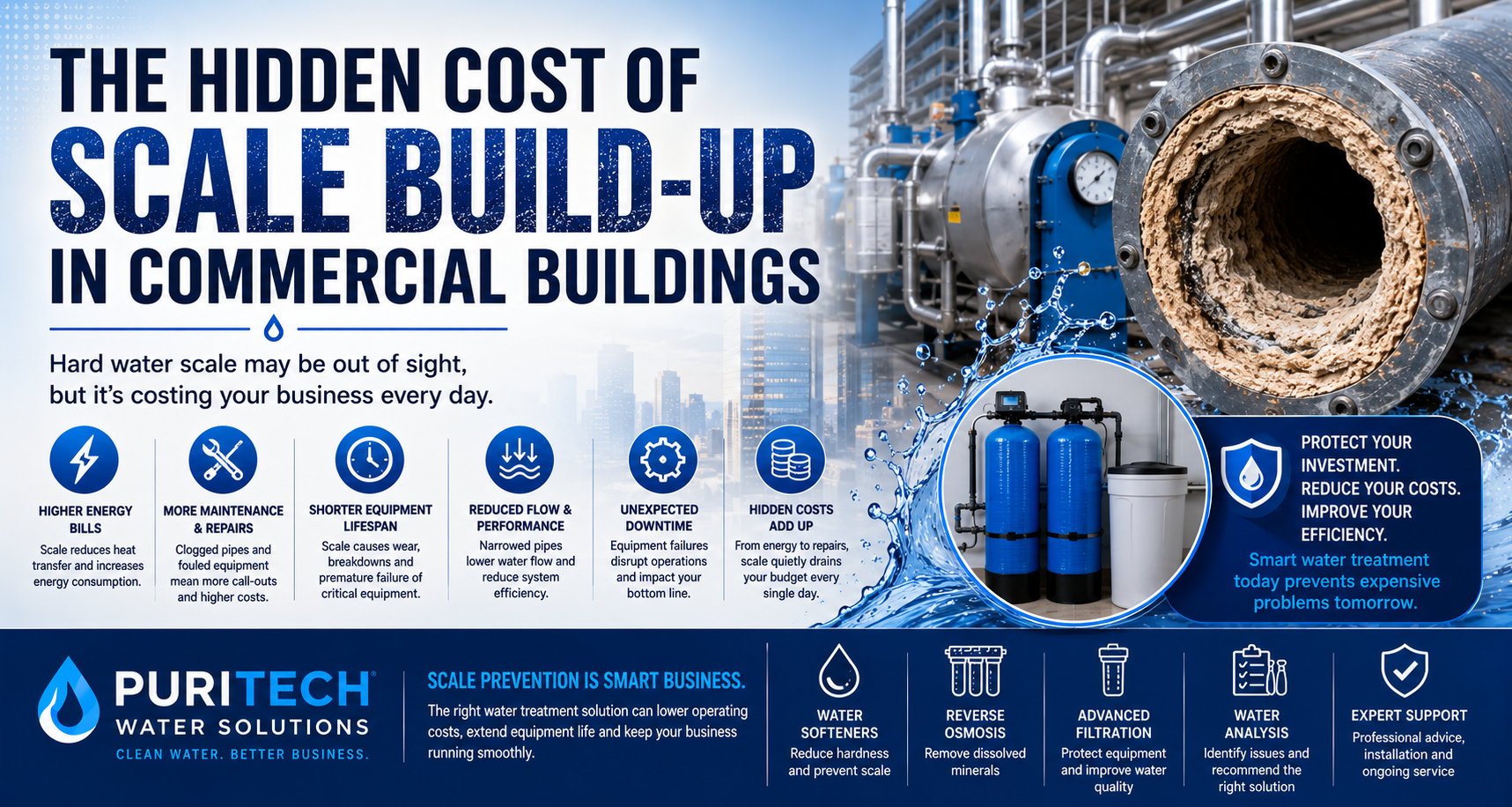
Higher Energy Consumption
Scale acts as an insulating layer between heating elements and water.
As a result, equipment requires more energy to transfer heat, increasing electricity or fuel consumption.
Even a relatively thin layer of scale can noticeably reduce heating efficiency.
Increased Maintenance Costs
Scale causes valves, pumps and heating systems to operate under greater stress.
Consequently, maintenance teams spend more time removing deposits, replacing components and repairing equipment.
Routine servicing also becomes more frequent and expensive.
Shorter Equipment Lifespan
Commercial equipment represents a significant capital investment.
However, continuous exposure to hard water scale accelerates wear on:
- Boilers
- Heat exchangers
- Pumps
- Water heaters
- Steam equipment
- Commercial appliances
Reducing scale helps maximise the return on these investments.
Unexpected Downtime
When boilers, pumps or hot water systems fail unexpectedly, normal business operations can be disrupted.
For hotels, restaurants, hospitals and manufacturing facilities, even a few hours of downtime can affect customer service and productivity.
Preventing scale reduces the likelihood of unexpected equipment failures.
Reduced Water Flow
Scale gradually narrows the internal diameter of pipes.
Over time, this restriction reduces water flow and pressure throughout the building.
Reduced flow may also force pumps to work harder, increasing energy consumption and mechanical wear.
Poor Performance of Commercial Equipment
Many commercial appliances rely on efficient heat transfer.
Scale can reduce the performance of:
- Commercial dishwashers
- Steam ovens
- Coffee machines
- Ice machines
- Laundry equipment
- Sterilisation equipment
Lower performance often results in longer operating cycles and higher utility costs.
Which Commercial Buildings Are Most Affected?
Any facility that uses significant amounts of hot water can experience scale-related problems.
Industries commonly affected include:
- Hotels
- Hospitals
- Restaurants
- Schools
- Universities
- Office buildings
- Shopping centres
- Food processing plants
- Manufacturing facilities
- Commercial laundries
- Car washes
The harder the incoming water, the greater the likelihood of scale formation.
How to Prevent Scale Build-Up in Commercial Buildings
Preventing scale build-up in commercial buildings is far more cost-effective than removing hardened deposits after they have formed. By taking proactive measures, businesses can improve efficiency, reduce maintenance costs, and extend the lifespan of critical equipment.
Test Your Water First
Every commercial property has unique water quality characteristics.
A professional water analysis identifies important parameters such as the following:
- Hardness
- Calcium
- Magnesium
- Iron
- Manganese
- pH
- Total Dissolved Solids (TDS)
- Conductivity
These results provide the information needed to recommend the most effective treatment solution.
Install a Water Softener
Water softeners are one of the most effective ways to reduce scale caused by hard water.
They remove calcium and magnesium before the water reaches the following:
- Boilers
- Water heaters
- Heat exchangers
- Commercial kitchens
- Laundry equipment
- Hot water systems
By reducing hardness, water softeners help prevent new scale from forming and improve overall equipment efficiency.
Use Reverse Osmosis Where High-Purity Water Is Required
Some commercial applications require exceptionally low mineral content.
Reverse osmosis systems remove a wide range of dissolved minerals and are commonly used for:
- Food and beverage production
- Pharmaceutical applications
- Laboratories
- Steam generation
- High-pressure boilers
- Spot-free rinse systems
When properly designed with suitable pre-treatment, reverse osmosis significantly reduces the risk of mineral deposits.
Maintain Equipment Regularly
Routine inspections help identify scale before it causes serious problems.
Maintenance should include:
- Checking heating efficiency
- Inspecting heat exchangers
- Monitoring water pressure
- Cleaning strainers and filters
- Servicing water treatment equipment
Preventative maintenance reduces unexpected failures and costly downtime.
Replace Filters as Recommended
Pre-filtration protects downstream equipment from sediment and suspended solids.
Replacing filter cartridges according to the manufacturer’s recommendations helps maintain consistent system performance and supports the overall treatment process.
The Return on Investment of Scale Prevention
Many businesses focus on the cost of installing water treatment equipment. However, the long-term savings often outweigh the initial investment.
Reducing scale can help:
- Lower electricity consumption
- Extend equipment lifespan
- Reduce emergency repair costs
- Improve heating efficiency
- Minimise production downtime
- Reduce maintenance requirements
- Improve operational reliability
For facilities that rely heavily on hot water or steam, these savings can accumulate significantly over the lifetime of the equipment.
Frequently Asked Questions
What causes scale build-up?
Scale forms when dissolved minerals—primarily calcium and magnesium—precipitate out of hard water and attach to surfaces, especially when water is heated.
Can scale damage commercial equipment?
Yes. Scale reduces heat transfer, restricts water flow, and increases mechanical stress on boilers, pumps, valves, heat exchangers, and other equipment.
How do I know if my building has hard water?
A professional water analysis is the most reliable way to determine water hardness and identify other water quality issues that may affect your equipment.
Is a water softener always the best solution?
Not always. While water softeners are highly effective for reducing hardness, the best solution depends on your water analysis and the specific application. In some cases, reverse osmosis or a combination of treatment technologies may be recommended.
Conclusion
Scale build-up in commercial buildings is often overlooked until it begins affecting operating costs, equipment performance and business continuity. Although mineral deposits form gradually, they can lead to higher energy consumption, increased maintenance, reduced water flow and premature equipment failure.
Fortunately, these problems are largely preventable. Starting with a professional water analysis allows businesses to understand their water quality and implement the most appropriate treatment solution. Whether that involves water softening, reverse osmosis, filtration or a combination of technologies, proactive water treatment helps protect valuable assets and reduce long-term operating costs.
If your commercial property is experiencing the effects of hard water, Puritech can assess your water quality and recommend a customised treatment system designed to improve efficiency, reduce maintenance and protect your investment.